Gangster Disciples
luxury-insider

Thursday, 28 June 2012

Animal-human hybrid stickers invading Parisian streets


Suriani-16.jpg

While marketing and mainstream communications campaigns have derived branding inspiration in the comic-like cartoon style of street art, and the values attached to its culture—freedom, community, transgression—the paradox still exists to see it framed and sold through traditional art channels.

Suriani-1.jpg

We caught up with street artist Rafael Suriani at his recent show, "Collages Urbains", at Cabinet d'amateur gallery in Paris, where he told us more about street art and his relationship with the medium.

Suriani-4.jpg

Suriani's mark features animals, surviving and thriving in the streets for its powerful and highly recognizable aesthetic. In his half-human-half-animal figures, the animal faces act as liberating masks, allowing the artist to express social criticism in an elegant way. The vibrant, seemingly playful creatures refrain from getting too serious and maintain a suggestive tone that avoids the obvious.

Suriani-8.jpg Suriani-3.jpg

The stickers are the result of a double-binding process that first assembles man and animal, then adheres the resulting figure to the wall. In the past, Suriani has drawn from his Latin-American heritage, playing with shamanic mythology figures such as toucan or jaguar. In his recent series, on the other hand, he is more interested in urban domestic animals such as cats and dogs—according to the artist, the convention that they tend to resemble their owners offers a metaphoric way to talk about us people. Recently Suriani made a series of French "Bulldogs" as a special dedication on London walls, using this breed to cartoon and make fun of some French characteristics. Each dog expresses a different state of mind—humor, spirituality, criticism or beauty.

Suriani-9.jpg Suriani-10.jpg

Suriani uses the rare technique of hand-painting every poster he sticks on the streets. Making each sticker is the result of a process involving selecting photos from the Internet, cutting them in Photoshop, then screening and painting before cutting the final product. Such repetition lies at the heart of street art practice, which is often based on plastering as many spots as possible, invasion-style.

Suriani-17.jpg

When considering the ephemeral fate of the piece of work destined for degradation of the elements, police destruction or theft from passers-by, the time and effort for such little reward seems remarkable. Suriani explains, however, that the fleeting nature of his work is freeing and allows him to be audacious with both subject and technique. To him, because there is no pressure or constraint, that achievement is rarely a failure.

Suriani-11.jpg

In the end, the piece of art is not the only sticker by itself, it is the sticker in its context, seen as a whole on the wall with the daylight shining on it, the motorbikes parked against it or the branch of a tree creeping across. Rarely is the work's time spent on the wall its only life, after all, with the rise of dedicated photographers immortalizing the scenes for the Internet.

Suriani-7.jpg

Suriani claims his intention to step into the city's landscape by bringing much-needed beauty comes with a positive message. Rather than being aggressive or controversial, Suriani takes pleasure in having people on the street enjoy his figures. His work is bound to the city—physically, geographically and socially—compelling the public to refresh their view of their surroundings and drawing their eyes to the places that typically go unnoticed. As an architect, Suriani has found a way to unveil the city and change people's perception of the scenes they see everyday without truly seeing them. The choice of venue is very important, based on aesthetic consideration with attention to the context and surroundings like the location.

EURO 2012 POSTERS BY DAVID WATSON

Euro 2012 Posters by David Watson

Euro 2012 recently began and, for those of you who don’t know, it’s the European football championship. European football is what we Americans call soccer, and it has slowly gained steam over the years, although still not as popular as American football…  Whether you’re into the championship or not (or even sports in general), you’ll probably love these simple, modern posters David Watson ofTrebleseven designed for it.

 Euro 2012 Posters by David Watson

Each poster represents a particular country that’s playing, and the colors of their flag are incorporated into one of the various circular designs. I love the typographic twist these posters have and how they don’t have blatant sports references in them.

Euro 2012 Posters by David Watson

Euro 2012 Posters by David Watson

Euro 2012 Posters by David Watson

Euro 2012 Posters by David Watson

Euro 2012 Posters by David Watson

Euro 2012 Posters by David Watson

Euro 2012 Posters by David Watson

Euro 2012 Posters by David Watson


Tuesday, 26 June 2012

Six Britons arrested on Mallorca for making threats, extortion and drug trafficking

The Guardia Civil in Palmanova, Mallorca, has arrested six Britons in connection with the crimes of making threats, extortion and drug trafficking. After passing through the court, the judge on Monday ordered the imprisonment of two of the men. In the early hours of June 22 several Guardia went to Calle Punta Ballena after hearing of threats made against several workers in the leisure industry in the nightlife area of Magaluf by a group of English individuals. After being identified by their victims several were detained. Their intention had to be that youngsters who went to find clients for the clubs also offered drug and made threats with knives and physical violence. The Guardia Civil impounded two knives during the arrests, 34 ecstasy pills in several bags, 1.5 grams of cocaine and 340 € in small notes. A search of the hotel where the Brits were saying found 1,000 € in cash, three baseball bats, two knives, a machete and a mask. The Guardia Civil say the investigation continues and more arrests have not been ruled out.

Saturday, 23 June 2012

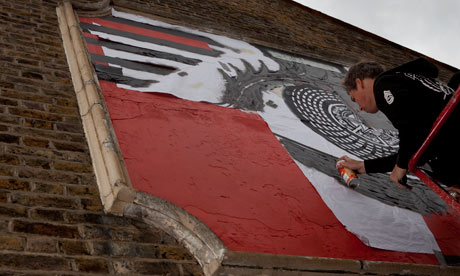
American street artist Frank Shepard Fairey works on his latest piece, Envision, above a shop in Turnpike Lane

American street artist Frank Shepard Fairey
.Photograph: Teri Pengilley

The natural territory of the street artist Shepard Fairey would seem to be as all-American as it gets. Emerging from the country's skateboarding scene he achieved global prominence with his much copied, much parodied Hope poster displaying a stylised Barack Obama in shades of blue and red.

He spent much of Friday assembling his latest street mural in a seemingly less likely locale – a suburban street in Turnpike Lane, one of north London's more economically mixed neighbourhoods.

Hoisted aloft by a rented cherry picker, the 42-year-old artist used stencils and paint to create Envision, an image of a giant, stylised eyeball design, set in the frame of a disused Victorian placard site on the wall of a local shop.

The unlikely public commission, carried out with any charge by the artist, was the almost accidental result of a wider community regeneration programme carried out by the local council, Haringey, and the green travel charity Sustrans.

In getting together to decide options for more pedestrian-friendly street layouts, locals pondered what to do with the crumbling and slightly tatty shop wall, and decided the existing frame left by the long-disappeared Victorian placard would be best filled by a mural.

James Straffon, a local who helped organise the project, went to a London art gallery specialising in graffiti artists to seek help.

He said: "The woman from the gallery asked: 'Ideally, who would you like?' I said: 'I know it would never happen, but Shepard Fairy.' She said: 'Shall I get in touch with him, then?' I stuck my neck out and said yes and sent them a diagram with the sizes, thinking nothing would happen. Literally a week later they said, he's interested and he's coming over."

Straffon says he remains unsure why such a celebrated artist would be interested in a relatively out-of-the-way location. He said: "I think what sold it was that it's an old Victorian billboard. I think they like the fact it's the old London thing."

Before Fairey arrived, Straffon and some neighbours spent a day preparing the wall, painting it in a specified shade of red for a background to the stencilled design.

The US artist and his team spent several hours in decidedly mixed weather putting the design in place. Straffon said: "He's come from west coast America to dreary, sodden London. He must be thinking: 'Great, I've got to do this.' It's quite windy, too."

Another oddity is that this is Turnpike Lane's second work by a globally-known street artist in a matter of months. Last month, a mural believed to be by Banksy, a rough UK equivalent to Fairey, appeared on the wall of the area's local Poundland shop, showing a child sweatshop worker sewing jubilee bunting.

George Washington's copy of US constitution sells for $9.8m

George Washington
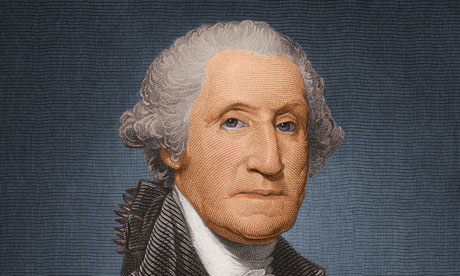
Portrait of George Washington, whose personal copy of the US Constitution and Bill of Rights fetched $9.8m at auction. Photograph: Stock Montage/Getty Images

George Washington's personal copy of the US constitution and bill of rights sold for $9.8m (£6.3m) at auction on Friday, setting a record for any American book or historic document.

Bidders at Christie's New York salesroom and others on the telephone competed for the first US president's signed, gold-embossed volume dating to 1789, which had a pre-sale estimate of up to $3m.

The non-profit Mount Vernon Ladies Association of the Union, which maintains the historic Mount Vernon estate in Virginia that was Washington's home and is now open to the public, was the successful bidder.

"The unique book had been in the Mount Vernon library until 1876, and will soon be returned to that library," said Chris Coover, senior specialist of books and manuscripts at Christie's.

The bound volume was Washington's personal copy of the Acts of Congress and is noteworthy for his bold signature marking it as his own.

The Acts of Congress include the Constitution, whose preamble promises to "secure the blessings of liberty to ourselves and our posterity," and the Bill of Rights, the first 10 amendments to the constitution, which establish such fundamental liberties as the right to free speech, press, assembly and religion.

Christie's described the book as being in near-pristine condition after 223 years. It was specially printed for Washington in 1789, his first year in office as president.

The margins include Washington's handwritten brackets and notations highlighting key passages concerning the president's responsibilities.

The Acts of Congress volume was sold from Washington's library at Mt Vernon in 1876 and eventually bought at auction by collector Richard Dietrich in the 1960s. It was being sold by the family's estate.

Similar volumes created for Thomas Jefferson, the first secretary of state and third US president, and attorney general John Jay, are in Indiana's Lilly Library and a private collection, respectively.

Rare books and manuscripts have achieved impressive prices in recent years.

An autographed manuscript of Lincoln's 1864 election victory speech sold for $3.4m in February 2009, which set a record for an American manuscript at the time. A 1787 letter written from Washington to his nephew on the subject of the ratification of the Constitution fetched $3.2m in December 2009.

ASTON MARTIN ONE-77

performance@holmesandco-london.com

ASTON MARTIN ONE-77


Car No.40 of 77 Made.


The Client is seeking 1.2 Million Sterling for the Car.


The Cars were originally sold by Aston Martin for 1Million, plus costs.


Equivalent cars are available for 2 Million Sterling – 2.7 Million Dollars.


We are Offering the Car at 1.4 Million, but it should be considerably more.


Our Client wishes for the Sale to be Confidential, and approaching clients will need to provide documents

Wednesday, 20 June 2012

Fatal shooting possibly to bolster San Bernardino gang

Anthony Phillips, 26, of San Bernardino, is accused of fatally shooting Maurice Major, 29, of Riverside, at an apartment complex in the 1200 block of North Sierra Way. Phillips was arrested the next day. He is charged with one count of murder, and prosecutors have added a gang enhancement for Phillips' alleged involvement in a San Bernardino gang. Phillips, who was in San Bernardino Superior Court on Thursday, has pleaded not guilty to the charges. During the hearing in front of Judge James Dorr, a detective and an officer from the San Bernardino Police Department were called as witnesses. They testified about the shooting and gangs in the area. Phillips, also known as Ant, is affiliated with the Delmann Heights Bloods, said Officer Jonathan Plummer, a gang investigator with the San Bernardino Police Department. "(The shooting) enhances the gang by sending a message to rival gang members and to the community - that Delmann Heights is very violent," Plummer said. The officer testified about Phillips' reported noteworthy tattoos, including "DH" under his eyes, "Bloods" on his body, "San Murderdino" on his abs and "Delmann Heights" on both arms. Witnesses told police that Major was also a gang member, Detective Albert Tello testified. Advertisement His street name was West and he was affiliated with the West Covina Neighbor Hood Crips out of Los Angeles County. Recently, Los Angeles County gangs have come into the Inland Empire to sell drugs, Plummer said. Delmann Heights, which has more than 150 documented members, claims the boundaries of California Street to the west, Medical Center Drive to the east, Cajon Boulevard to the north and Highland Avenue to the south, according to police. Following a recent gang injunction in Delmann Heights, several DH members have migrated over to the 1200 block of Sierra to sell narcotics, Plummer said. Major's girlfriend told police that on the night of the shooting they were at a party outside a San Bernardino apartment complex, Tello testified. She told police that 20 to 30 people were there, including Phillips. The two men were familiar with each other, she told police, and at one point Phillips approached Major and asked to speak with him, Tello testified. The two walked away, Tello said, and while they were talking they got into an argument. Phillips then allegedly shot the victim several times in the chest, the girlfriend told police. "After he shot the victim, the suspect ran from the complex, put the gun away and ran toward Fame Liquor," on Base Line, Tello relayed on the witness stand. Major was taken to a local hospital, where he was later pronounced dead. Deputy District Attorney David Tulcan said prosecutors are still investigating whether Major had a gun on him that night. Authorities did find a clear, plastic bag with several pieces of suspected rock cocaine on the victim, police said. Testimony in the preliminary hearing will continue on Monday, where a judge is expected to set trial dates. May was a deadly month for the city. There were 12 reported homicides - five in one week. The spate of May violence prompted memories of the 1990s, when gang violence peaked in the area. The number of people killed in the city this year is up to 23

ranking member of the Fruit Town Brims set of the Bloods street gang was sentenced to 63 months in prison Wednesday

A Jersey City man who is a ranking member of the Fruit Town Brims set of the Bloods street gang was sentenced to 63 months in prison Wednesday for his role in the gang’s criminal enterprises, officials said. Tequan Ryals, 34, had pleaded guilty to racketeering conspiracy before U.S. District Court Judge Stanley R. Chesler, who imposed the sentence in Newark federal court Wednesday, U.S. Attorney Paul J. Fishman said. Ryals, with fellow gang members, conspired to distribute quantities of heroin in Jersey City between December 2008 and February 2009, according to court documents and statements. Ryals also made two drug sales monitored by law enforcement in December 2008, officials said. Ryals, who was involved in the daily activities of the Fruit Town Brims from 2004 until his arrest, acted as a middleman drug distributor, officials said. Ryals was supplied “bricks” of heroin by an associate of the set and he resold them to gang members, officials said. The indictment unsealed in January 2011 charged Ryals and 14 other defendants with racketeering conspiracy and other offenses including acts pertaining to murder, murder conspiracy, aggravated assaults, a kidnapping, firearms offenses and various drug distribution conspiracies, officials said. The gang members charged in the indictment ran the gang’s activities in Jersey City, Newark, Paterson and other locations, officials said. In November, Ryals completed a state prison term for drug crimes, corrections records say. Last week, 30-year federal prison terms were meted out to Emmanuel Jones, 28, of Jersey City, and Torien Brooks, 31, of Paterson, both members of the Fruit Town and Brick City Brims set of the Bloods, officials said. Jones and Brooks were charged in the July 2004 murder of 17-year-old Michael Taylor of Jersey City, who was gunned down in a case of mistaken identity during gang retaliation, officials said. Fishman credited a number of law enforcement agencies for the investigation leading to Ryals’ conviction, including the Hudson County Prosecutor’s Office, Hudson County Sheriff’s Office, and Jersey City Police Department.

Mob snitch who botched three hits ratted out Colombo gangster in murder trial

A mob snitch who couldn’t shoot straight easily pointed the finger at a reputed Colombo gangster on trial for murder. Dino Basciano took the witness stand in Brooklyn Federal Court to testify that he heard Frank (BF) Guerra was part of a hit team that successfully whacked Joseph Scopo in 1993. Basciano, 56, wasn’t much of a hit man himself, botching at least three rubout attempts. In one case, he shot Patricia Capozzalo, the sister of Peter (Fat Pete) Chiodo, telling defense lawyer Gerald McMahon, “I knew I didn’t kill her. She was still screaming when we left.”

Slain teen Ramarly Graham's twin brothers convicted of heading gang

The twin half brothers of Ramarley Graham, the Bronx teen fatally shot by a police officer in February, were convicted Tuesday for gun possenion and being part of a Harlem street gang. Hodean and Kadean Graham were sentenced to eight years in jail for heading a crew known as "One-Twenty-Nine" and "Goodfellas/The New Dons" between 2007 and 2011 in the area around W. 129th Street, between Lenox and Fifth Avenues. The 20-year-old brothers were cleared of attempted murder. "This violent street gang was as young as it was dangerous, its members having been involved in multiple shootings over a four-year period," Manhattan District Attorney Cy Vance said in a statement. Fifteen members of the gang were convicted on charges of drug dealing and weapons possession. Last week, police officer Richard Haste, 31, pleaded not guilty to manslaughter for shooting Ramarley Graham in the Bronx while officers were investigating a drug deal. As officers made the bust, they were radioed that Graham was armed, when he in fact was not. Graham was shot was trying to flush a bag of marijuana down a toilet. Haste's attorney said in court that the officer was conviced the teen was carrying a weapon.

Tuesday, 12 June 2012

shooting a cop dead is now legal in the state of Indiana.

Governor Mitch Daniels, a Republican, has authorized changes to a 2006 legislation that legalizes the use of deadly force on a public servant — including an officer of the law — in cases of “unlawful intrusion.” Proponents of both the Second and Fourth Amendments — those that allow for the ownership of firearms and the security against unlawful searches, respectively — are celebrating the update by saying it ensures that residents are protected from authorities that abuse the powers of the badge. Others, however, fear that the alleged threat of a police state emergence will be replaced by an all-out warzone in Indiana. Under the latest changes of the so-called Castle Doctrine, state lawmakers agree “people have a right to defend themselves and third parties from physical harm and crime.” Rather than excluding officers of the law, however, any public servant is now subject to be met with deadly force if they unlawfully enter private property without clear justification. “In enacting this section, the general assembly finds and declares that it is the policy of this state to recognize the unique character of a citizen's home and to ensure that a citizen feels secure in his or her own home against unlawful intrusion by another individual or a public servant,” reads the legislation. Although critics have been quick to condemn the law for opening the door for assaults on police officers, supporters say that it is necessary to implement the ideals brought by America’s forefathers. Especially, argue some, since the Indiana Supreme Court almost eliminated the Fourth Amendment entirely last year. During the 2011 case of Barnes v. State of Indiana, the court ruled that a man who assaulted an officer dispatched to his house had broken the law before there was “no right to reasonably resist unlawful entry by police officers.” In turn, the National Rifle Association lobbied for an amendment to the Castle Doctrine to ensure that residents were protected from officers that abuse the law to grant themselves entry into private space. “There are bad legislators,” the law’s author, State Senator R. Michael Young (R) tells Bloomberg News. “There are bad clergy, bad doctors, bad teachers, and it’s these officers that we’re concerned about that when they act outside their scope and duty that the individual ought to have a right to protect themselves.” Governor Daniels agrees with the senator in a statement offered through his office, and notes that the law is only being established to cover rare incidents of police abuse that can escape the system without reprimand for officers or other persons that break the law to gain entry. “In the real world, there will almost never be a situation in which these extremely narrow conditions are met,” Daniels says. “This law is not an invitation to use violence or force against law enforcement officers.” Officers in Indiana aren’t necessarily on the same page, though. “If I pull over a car and I walk up to it and the guy shoots me, he’s going to say, ‘Well, he was trying to illegally enter my property,’” Sergeant Joseph Hubbard tells Bloomberg. “Somebody is going get away with killing a cop because of this law.” “It’s just a recipe for disaster,” Indiana State Fraternal Order of Police President Tim Downs adds. “It just puts a bounty on our heads.”

Related Posts Plugin for WordPress, Blogger...

Share

Twitter Delicious Facebook Digg Stumbleupon Favorites More